What happens when a mobile network needs to go somewhere fiber cannot?
For most modern mobile networks, connectivity begins with infrastructure.
Fiber connects sites. Towers host radios. Backhaul connects the radio network to the operator’s core. This model works extremely well – when the infrastructure is available.
But what happens when it isn’t?
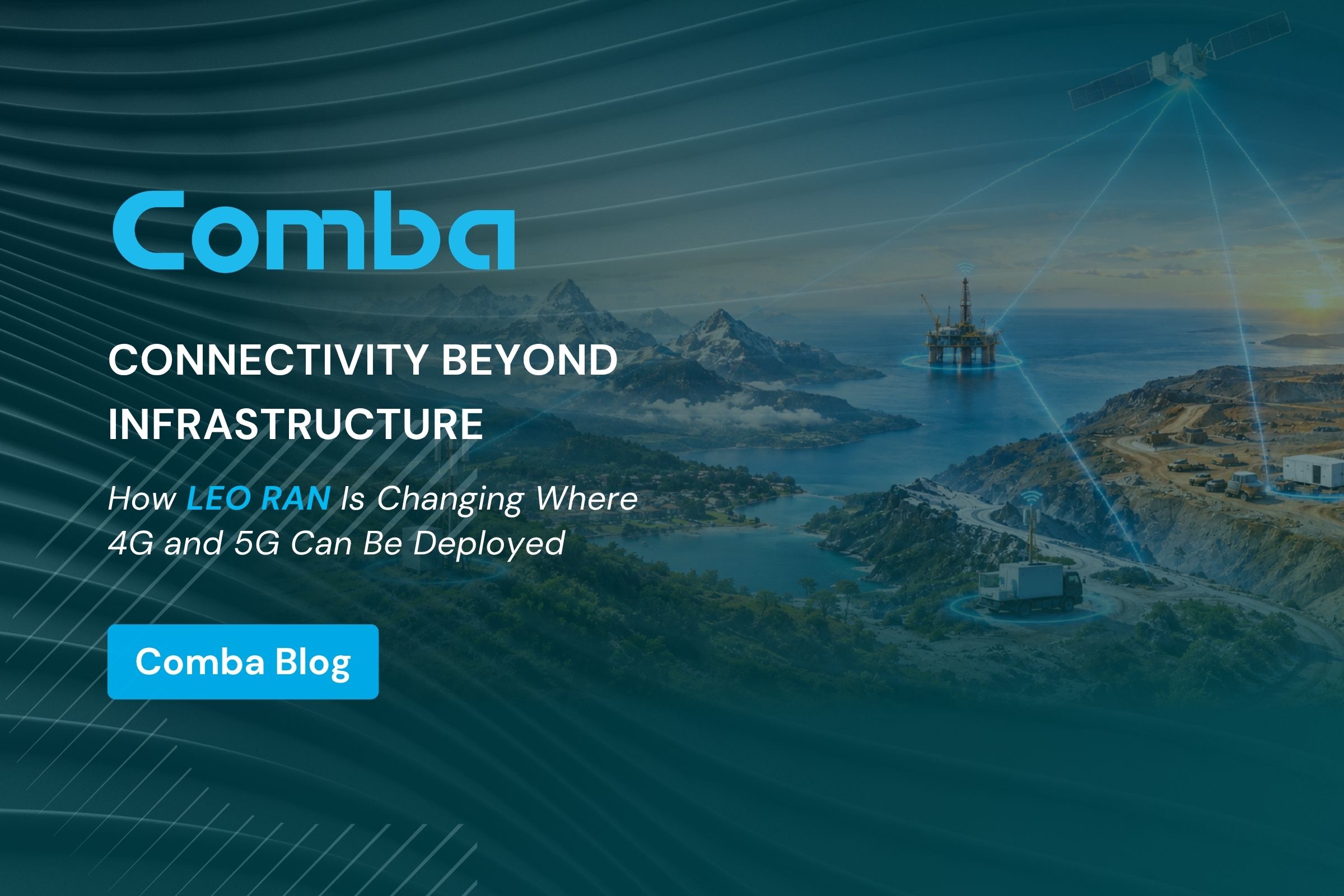
A remote village. A mountain site. An offshore platform. An isolated industrial facility. A disaster-stricken area where terrestrial infrastructure has been damaged.
In these environments, deploying conventional cellular infrastructure can become expensive, time-consuming or simply impractical.
This is where Low Earth Orbit (LEO) satellite connectivity can change the equation.
From satellite connectivity to cellular connectivity
LEO satellites are not new. What is changing is how they can be integrated into terrestrial communications networks.
The concept behind LEO RAN is relatively simple:
Use LEO satellite connectivity as the backhaul for a 4G or 5G radio network.
Instead of connecting a remote RAN site to the operator’s network through fiber or another terrestrial connection, the site can use a LEO connection to reach the network.
In simplified terms:
User → Comba RAN → LEO backhaul → Satellite → Ground Gateway → Core Network
The satellite provides the connection between the remote site and the wider network.
The cellular RAN still does what it has always done: it provides the local 4G or 5G wireless connection to users and devices.
This distinction is important.
LEO does not replace the cellular network. It can provide an alternative way of connecting that network.
Why does this matter?
Traditional terrestrial infrastructure can be difficult to deploy in geographically challenging environments.
Fiber deployment can require trenching, civil works, permits and significant investment. Mountains, islands, deserts and offshore locations can make the economics even more challenging.
LEO backhaul offers another option.
By connecting a RAN site through satellite, operators can potentially deploy coverage without waiting for long-distance terrestrial infrastructure to be constructed.
That creates three important advantages:
Faster deployment
Remote sites can potentially be connected without waiting for extensive fiber construction or other terrestrial works.
Greater flexibility
The same architecture can be adapted to different deployment scenarios, from rural coverage to temporary networks and emergency communications.
Improved resilience
LEO connectivity can also provide an alternative communication path when terrestrial infrastructure is unavailable or disrupted.
Where can LEO RAN make a difference?
The opportunity extends well beyond rural connectivity.
Rural and remote areas
LEO backhaul can help operators extend 4G and 5G coverage to locations where conventional backhaul investment is difficult to justify.
Disaster recovery
When earthquakes, floods or other disasters damage terrestrial infrastructure, a rapidly deployable LEO-enabled RAN can provide an alternative route for restoring communications.
Remote industry
Mining sites, oil and gas facilities, remote factories and other industrial environments can use LEO connectivity as part of a private or public cellular architecture.
Maritime environments
Ships and offshore platforms cannot rely on conventional terrestrial fiber connections. LEO-enabled cellular connectivity can help extend 4G, 5G and Wi-Fi services into these environments.
Temporary and mobile deployments
Portable LEO-enabled RAN solutions can potentially provide connectivity where it is needed temporarily or where the network itself needs to move.
The Role of Comba
This is where the story becomes particularly interesting.
The value is not simply the satellite connection.
The satellite provides the backhaul. Comba provides the wireless network infrastructure that turns that connection into cellular connectivity.
Comba’s LEO RAN concept brings together LEO backhaul with a range of RAN architectures, including RAN gateways, macro and micro solutions, small cells and distributed RAN solutions.
This creates a flexible model:
One LEO backhaul technology. Multiple cellular deployment scenarios.
The result is a different way of thinking about network deployment.
Instead of asking:
“Where can we build terrestrial infrastructure?”
operators can increasingly ask:
“Where do we need connectivity—and what is the most effective way to get the network there?”
From infrastructure-dependent to infrastructure-flexible
Fiber will remain fundamental to global telecommunications networks.
LEO is not about replacing fiber everywhere.
It is about adding another option.
Where fiber makes sense, use fiber.
Where terrestrial infrastructure is difficult or uneconomic, LEO can provide an alternative.
Where resilience is critical, LEO can provide another path.
That creates the possibility of a more flexible, hybrid network architecture.
Connectivity Should Not Stop Where Infrastructure Ends
The next phase of network expansion will not simply be about increasing capacity in places that are already connected.
It will also be about extending reliable connectivity into places where traditional infrastructure struggles to reach.
That is the opportunity behind LEO RAN.
Comba is bringing together satellite backhaul and 4G/5G wireless infrastructure to help connect the places beyond traditional infrastructure.
Connect Beyond Infrastructure.
Comba Case Study